
The Angoris Estate
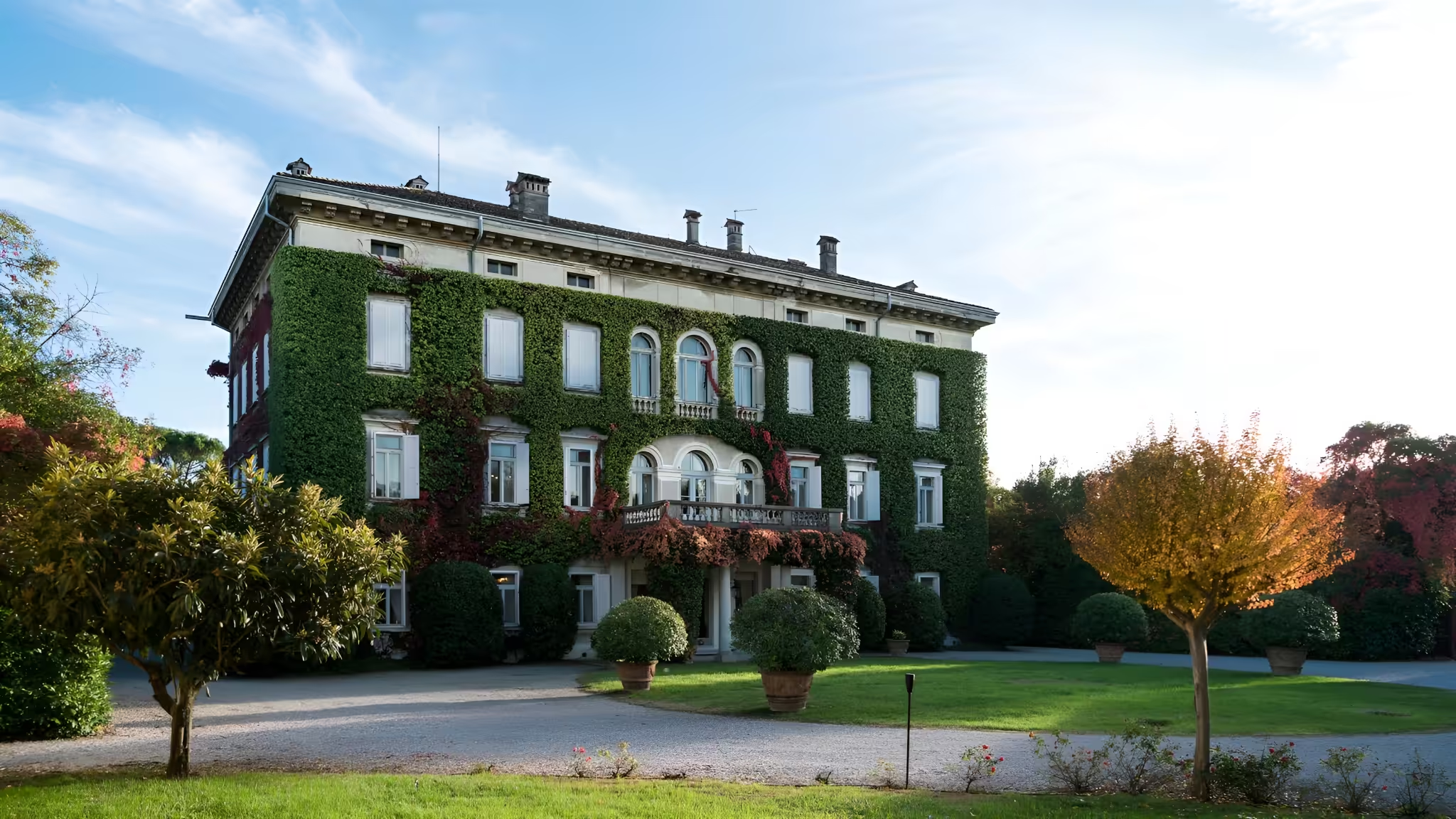
The history of the Angoris estate has deep roots, dating back to February 7, 1647, when the Austrian Emperor Ferdinand III granted 300 fields to Baron Locatello Locatelli. This grant was in recognition of his eighteen years of military service during the bloody Thirty Years’ War, which ended with the Peace of Westphalia in 1648. The lands, situated in the fertile area called Langoris — renamed Angoris in 1923 — became the foundation for one of the region’s most important estates.
The villa, likely built between the late 1600s and early 1700s, played a crucial role during World War I, when it was requisitioned by the Italian army and transformed into a large military hospital for the wounded from the Isonzo front. The land behind it became a cemetery where about 1,500 soldiers were buried; their remains were later moved to the Redipuglia memorial at the end of the conflict.
During the 20th century, the property passed through various hands until it came in 1939 to the Sacta company, owned by the Miani Counts, Friulian nobility and influential industrialists in the petroleum sector. In the 1950s, Count Miani revolutionised the estate by being the first in Cormons to bottle quality wines, establishing a thoroughbred horse breeding program, and planting new orchards.
It all began with Locatello Locatelli, an Austrian colonel and heroic figure of the Thirty Years’ War, whose intense gaze and playful locks are immortalised in a 17th-century engraving. Beneath his portrait is an enduring motto: “Di ben in meglio” (From good to better). Originating from a Bergamo family, Locatello was awarded the 300 fields in the fertile Cormons area by the emperor, marking the birth of the extraordinary Langoris estate — later renamed Angoris.
Among many fascinating details, Luigi Miani was a witness at the “wedding of the century” in 1949 between Tyrone Power and Linda Christian. Thanks to him, the Italo-American film crew of “A Farewell to Arms,” including stars like Rock Hudson and Alberto Sordi, arrived in Friuli. A passionate horse breeder, he created a stud farm where the legendary stallion Ribot spent his retirement years.
Angoris stands as a unique place — a captivating chapter in history linked to the countryside, the production of fine wines, agricultural experiments, and horse breeding. Notable figures have passed through here: Angoris even hosted a small zoo, whose king was a lion named Dolfo, pictured peacefully resting surrounded by the affection of his keepers. For literary gossip enthusiasts, it is said that Ernest Hemingway once visited the estate while the “A Farewell to Arms” crew was staying there.
Moreover, among the distinguished guests recorded in archives are Emperor Franz Joseph, who alighted at the Cormons train station, and King Victor Emmanuel III, who visited the hospital during the war. Photographs from the 1960s show President Giuseppe Saragat and Giulio Andreotti. These images, differing in era and tone, narrate how the world changed over time.
In 1968, the year the estate was acquired by Knight of Labour Giulio Locatelli, an industrialist from Pordenone and founder of major companies. Finally, it should be noted that Angoris, founded by a Locatelli military leader, later returned to another Locatelli family, not related to the previous dynasty. In between, a fundamental chapter was the era of Count Luigi Miani, originally from Martignacco, a wealthy oilman integrated in the Roman and international jet set.
 The Angoris Estate